Written by Riya Sharma, a Vedic astrologer with twelve years of practice.
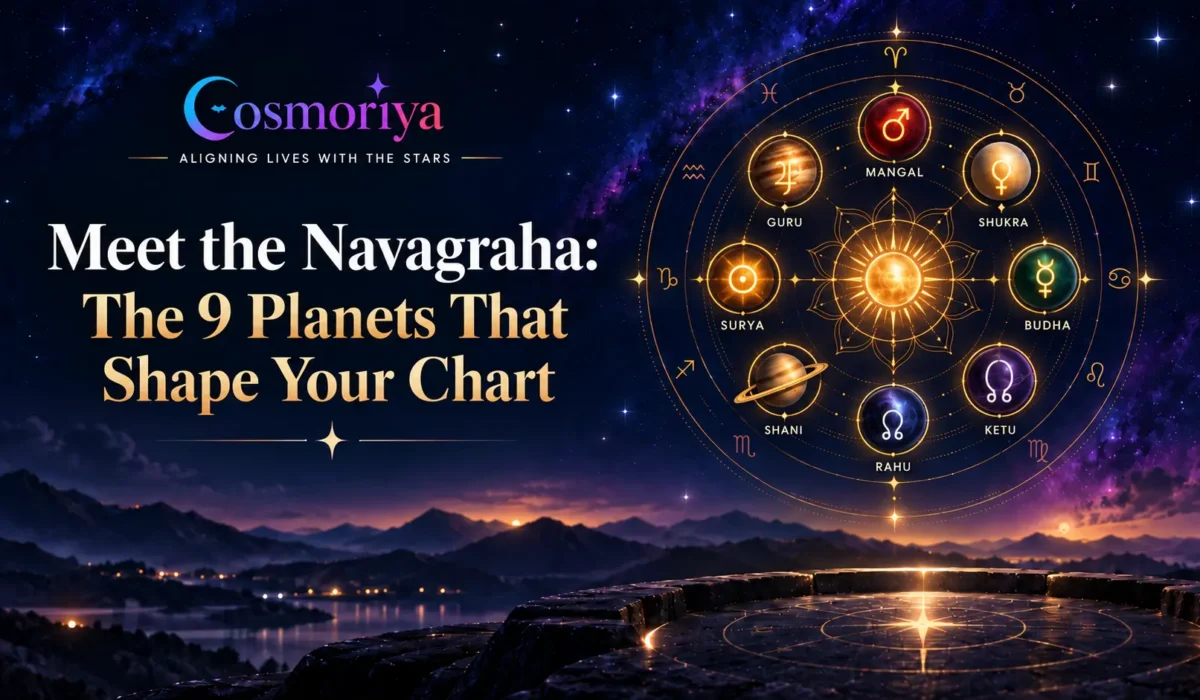
The 9 planets in Vedic astrology are the Navagraha. The set covers the seven visible bodies from Sun to Saturn plus two lunar nodes, Rahu and Ketu. Each graha rules certain themes. Its sign, house and dasha decide how those themes play out in your life.
The 9 planets are the cast of every Vedic chart. Your grandmother already knows some of them by weekday. Tuesday belongs to Mars. Saturday belongs to Shani. She fasts or offers oil accordingly.
Few people know what each graha rules. You’re not alone if you don’t. This guide walks you through all nine using everyday cues. You’ll see how friends, enemies, speed and dasha years change what the 9 planets do.
What the 9 Planets Mean
Graha means one who seizes. Each of the nine is seen as holding and shaping part of your life. Nava means nine, so Navagraha is the full set.
These are not the same nine bodies astronomy lists. Vedic astrology leaves out Earth, Uranus, Neptune and Pluto. It adds Rahu and Ketu, two points where the Sun and Moon paths cross.
| Planet | Sanskrit | Main themes | Weekday |
|---|---|---|---|
| Sun | Surya | Soul, authority, father | Sunday |
| Moon | Chandra | Mind, mother, comfort | Monday |
| Mars | Mangala | Courage, energy, property | Tuesday |
| Mercury | Budha | Speech, trade, learning | Wednesday |
| Jupiter | Guru | Wisdom, teachers, children | Thursday |
| Venus | Shukra | Love, art, comfort | Friday |
| Saturn | Shani | Discipline, delay, service | Saturday |
| Rahu | North node | Desire, ambition, foreign ties | None |
| Ketu | South node | Detachment, past karma | None |
Seven of the 9 planets rule a weekday. Rahu and Ketu have none. They do have a daily window, Rahu Kaal, that families avoid for fresh starts.
Meet Each Graha
Think of the 9 planets as nine colleagues in one office. Each has a job, a temper and a favourite corner.
Sun (Surya)
The Sun stands for the core self, authority and the father. A strong Sun gives steady confidence. A weak one can make you doubt your own voice, so you’ll feel it in meetings.
Moon (Chandra)
The Moon rules the mind, the mother and comfort. It changes sign every 2.25 days, so it shows your moods more than any other graha. Your rashi comes from it, as the sign by sign guide explains.
Mars (Mangala)
Mars gives courage, drive and a temper when pushed. It also rules land and property, which is why families ask about it before buying a flat. Its placement in some houses raises the Manglik question, covered in the Manglik dosha article.
Mercury (Budha)
Mercury runs speech, trade and learning. A well placed Mercury makes a quick student or a sharp shopkeeper. It turns backward a few times a year, which the Mercury retrograde article covers.
Jupiter (Guru)
Jupiter is the teacher. It stands for wisdom, children, faith and fortune. Its aspects tend to soften whatever they touch.
Venus (Shukra)
Venus governs love, art and comfort. It shapes how you give and receive affection and what you find beautiful.
Saturn (Shani)
Saturn brings discipline, delay and service. It rewards patient effort over years. Its slow transit sets off Sade Sati, which the Saturn transit article explains.
Rahu
Rahu pulls you toward desire, ambition and the unfamiliar. Foreign ties plus sudden change often sit in its territory.
Ketu
Ketu pulls the other way, toward detachment and spiritual insight. It carries the weight of past karma.
Friends and Enemies Among the Grahas
Among the 9 planets some pairs get along and others clash. The classical texts list natural friends, enemies and neutrals. A planet sitting in a friend’s sign feels at ease. In an enemy’s sign it strains.
| Planet | Friends | Enemies |
|---|---|---|
| Sun | Moon, Mars, Jupiter | Venus, Saturn |
| Moon | Sun, Mercury | None |
| Mars | Sun, Moon, Jupiter | Mercury |
| Mercury | Sun, Venus | Moon |
| Jupiter | Sun, Moon, Mars | Mercury, Venus |
| Venus | Mercury, Saturn | Sun, Moon |
| Saturn | Mercury, Venus | Sun, Moon, Mars |
Rahu and Ketu are usually read as behaving like Saturn and Mars. Texts differ on their friendships, so ask which source your reader follows.
Benefics and Malefics
Jupiter and Venus are natural benefics. A waxing Moon and a well placed Mercury join them. Saturn, Mars, Rahu and Ketu are natural malefics. Many schools add the Sun.
Natural labels for the 9 planets are only a start. Each ascendant turns some planets helpful and others hard. Saturn, for example, is a strong yogakaraka for Taurus and Libra ascendants. A harsh planet can deliver well when it is strong and placed with care.
Speed and Dasha Years of the 9 Planets
Planets don’t move at the same speed. Each also rules a block of years in the Vimshottari dasha. The blocks add up to 120. The table shows both numbers side by side.
| Planet | Dasha years | Time in one sign |
|---|---|---|
| Ketu | 7 | About 1.5 years |
| Venus | 20 | About a month |
| Sun | 6 | About a month |
| Moon | 10 | About 2.25 days |
| Mars | 7 | About 1.5 months |
| Rahu | 18 | About 1.5 years |
| Jupiter | 16 | About a year |
| Saturn | 19 | About 2.5 years |
| Mercury | 17 | About a month |
Rahu and Ketu always move backward through the signs. The rest of the nine move forward most of the time.
A Sub Period Worked Out
A sub period lasts main years multiplied by sub years then divided by 120. Rahu’s 18 years with a Jupiter sub period runs 18 x 16 / 120 = 2.4 years. Such windows are where a reader looks for timing.
How a Planet Is Read in a Chart
None of the 9 planets acts alone. Its effect depends on four things. They are the sign it sits in, the house it occupies, the planets it joins or looks at and the dasha it rules.
The house by house guide shows what each house governs. Pair that with the sign plus the planet’s friends for a clear picture.
Two Worked Chart Readings
Take Aditi with Capricorn rising. Her Saturn sits in Libra, her 10th house. Saturn is exalted in Libra, so it acts strongly. Career comes slowly then holds. Her reader checks the Saturn dasha for the years it peaks. The 10th house career article adds the career angle.
These readings show the 9 planets at work once sign and house are known. Now take Rohan with Aries rising. His Mars sits in Cancer, his 4th house. Mars is weak in Cancer. The 4th house governs inner peace at home. His reader asks about restlessness at home and checks Jupiter’s help. This placement also counts toward Manglik dosha.
Where the 9 Planets Show Up in Daily Life
Families meet the grahas long before they read a chart. Tuesday mandir visits, Saturday oil lamps. Both follow the weekday rulers. Many temples keep a small Navagraha shrine where you walk around all nine.
These customs are devotion, not diagnosis. A chart tells you which graha leads in your life right now. A reader can then suggest a practice that fits.
Strong, Weak and Combust Planets
A planet in its own sign or its exalted sign acts with confidence. In its debilitated sign it struggles. A planet too close to the Sun is called combust and loses strength. Readers check all three before judging any of the 9 planets.
Retrograde Planets
Planets appear to move backward at times. A retrograde graha is read as working inward or revisiting old matters. Rahu and Ketu always move this way, so the label matters only for the other five.
Common Mistakes With the Planets
Calling a Planet Evil
None of the 9 planets is evil. Saturn isn’t a villain and Jupiter isn’t a sure win. Strength, sign and house matter more than the label.
Reading One Planet Alone
A single placement doesn’t tell you much. Read sign, house, aspects plus dasha as one picture.
Buying a Gemstone From a List
A gemstone chosen from a name chart can backfire. Ask for a reason that comes from your own chart before you spend anything. You shouldn’t buy on a hunch.
Questions to Ask Your Reader
Which of the 9 planets rules your ascendant? Is it a functional benefic for you? Which dasha is on now and when does it end? Where do Rahu and Ketu sit? Raise these with your reader before agreeing to any remedy. A good reader doesn’t dodge and answers with reasons.
Related Reading
If the whole subject is new, begin with the Vedic astrology basics. To see why the Vedic nine differ from Western ones, read the sidereal and tropical article.
9 Planets FAQs
What are the Navagraha in Vedic astrology?
They are the Sun, Moon, Mars, Mercury, Jupiter, Venus, Saturn, Rahu and Ketu. Together they are called the Navagraha.
Which planet is the most powerful?
No planet is strongest for everyone. The ruler of your ascendant and the planet of your running dasha usually matter most.
Are Rahu and Ketu real planets?
No. They are lunar nodes, the points where the Sun and Moon paths cross. They have no mass yet act as strong karmic forces.
What are benefic and malefic planets?
Benefics such as Jupiter and Venus tend to ease things. Malefics such as Saturn and Mars bring pressure and growth. Placement can reverse either role.
Why does the Vimshottari dasha total 120 years?
Each of the 9 planets rules a fixed block. Ketu has 7, Venus 20, Sun 6, Moon 10, Mars 7, Rahu 18, Jupiter 16, Saturn 19 and Mercury 17. These add to 120.
Which planet rules which day?
The Sun rules Sunday and the Moon Monday. Mars rules Tuesday, Mercury Wednesday, Jupiter Thursday, Venus Friday and Saturn Saturday.
Can Riya explain the planets in your chart?
Yes. Riya reads each graha by sign, house and dasha, then shows you how they work together.
Nine Grahas and One Chart
Every chart uses the same nine grahas in a different arrangement. Learn what each one rules. The arrangement then starts to make sense.
The 9 planets function as a team. Give a reader your exact date, time and place. See each graha in context and let the whole chart tell the story.
Want to see how the 9 planets sit in your own birth chart? Riya reads each graha by sign, house and running dasha so you know which one leads right now. Book a consultation and bring exact birth details. The year ahead reading turns that map into a plan for the coming months.