Written by Riya Sharma, a Vedic astrologer with twelve years of practice.
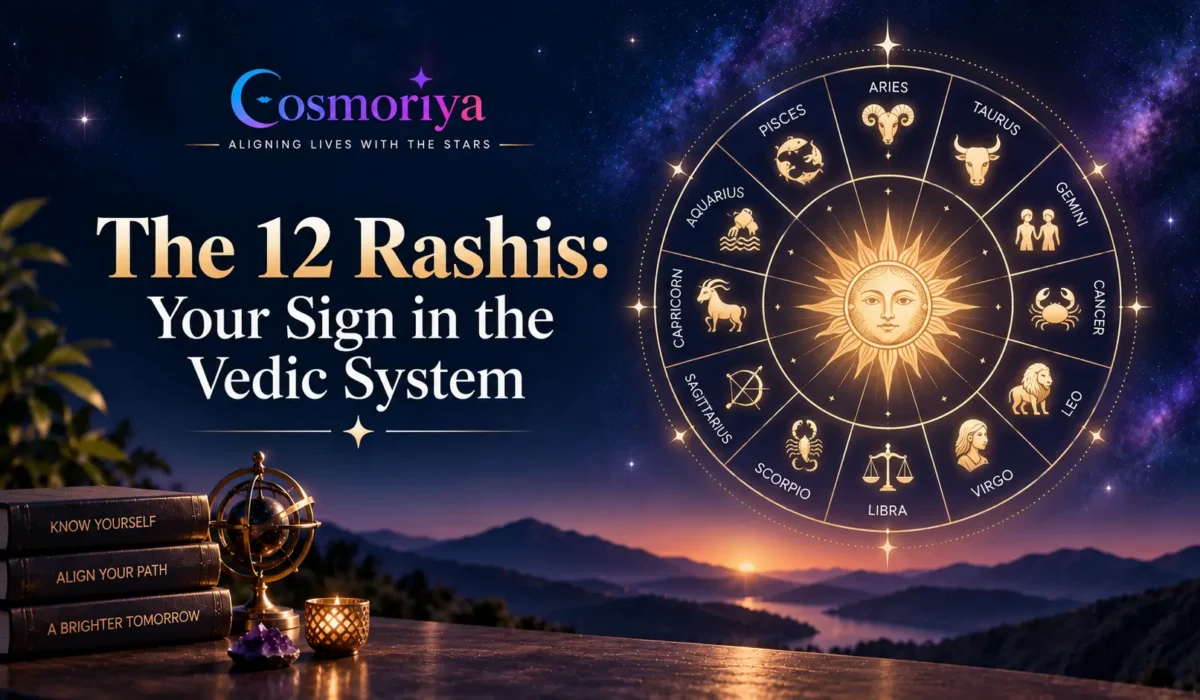
The twelve rashis are the zodiac signs of Vedic astrology, each a 30 degree slice of the sidereal zodiac. They run from Mesha to Meena. Each rashi carries a ruling planet, an element and a quality. Your own is the sign the Moon held at your birth.
The twelve rashis are where most families first meet Jyotish. A grandmother asks for your birth time and announces that you’re a Dhanu. A friend swears you’re a Scorpio. Both of them are right in their own system.
This guide gives you the whole wheel in one read. You’ll get the names, the rulers, the elements and the way to find your own rashi. It isn’t hard. Each sign also gets a short note so you can see how they differ.
What a Rashi Means in Vedic Astrology
Rashi means a heap or a collection. In Jyotish it names one of the twelve rashis, equal slices of the sky along the Sun’s path. Each slice spans 30 degrees, so the full circle comes to 360.
The signs are fixed to the stars and the houses are not. Your birth time decides which sign rises first and where the houses begin. That split is why a chart needs both signs and houses to read.
The Twelve Rashis at a Glance
| Rashi | English | Ruler | Element | Quality |
|---|---|---|---|---|
| Mesha | Aries | Mars | Fire | Movable |
| Vrishabha | Taurus | Venus | Earth | Fixed |
| Mithuna | Gemini | Mercury | Air | Dual |
| Karka | Cancer | Moon | Water | Movable |
| Simha | Leo | Sun | Fire | Fixed |
| Kanya | Virgo | Mercury | Earth | Dual |
| Tula | Libra | Venus | Air | Movable |
| Vrishchika | Scorpio | Mars | Water | Fixed |
| Dhanu | Sagittarius | Jupiter | Fire | Dual |
| Makara | Capricorn | Saturn | Earth | Movable |
| Kumbha | Aquarius | Saturn | Air | Fixed |
| Meena | Pisces | Jupiter | Water | Dual |
Read the table from Mesha down to Meena. The order never changes. Only the planets move through it. Each sign keeps its place.
Why Five Planets Rule Two Signs
Across the twelve rashis only the Sun and the Moon rule one sign each. Mars, Mercury, Jupiter, Venus and Saturn rule two each. Each pair has one day sign and one night sign. Mars takes Mesha and Vrishchika. Venus takes Vrishabha and Tula. Mercury takes Mithuna and Kanya. Jupiter takes Dhanu and Meena. Saturn takes Makara and Kumbha. Rahu and Ketu rule no sign in the common classical scheme.
Exaltation and Debilitation
Seven planets gain strength in one of the twelve rashis and lose it in another. The table shows each pair. A reader weighs this before judging any placement. The nine planets guide describes the role of each planet.
| Planet | Exalted in | Debilitated in |
|---|---|---|
| Sun | Mesha | Tula |
| Moon | Vrishabha | Vrishchika |
| Mars | Makara | Karka |
| Mercury | Kanya | Meena |
| Jupiter | Karka | Makara |
| Venus | Meena | Kanya |
| Saturn | Tula | Mesha |
Elements and Qualities Together
Every one of the twelve rashis has an element and a quality. Elements set the basic temperament. Fire signs push. Earth signs build. Air signs think and talk. Water signs feel.
Qualities describe how a sign handles energy. Movable signs start things. Fixed signs hold on. Dual signs adapt. Pair the two and each sign has a clear address. Mesha is movable fire while Simha is fixed fire. Karka is movable water while Meena is dual water.
Each Rashi in Brief
These notes treat each of the twelve rashis as a Moon placement. They give you a first impression and never a full reading.
Mesha (Aries)
Mars rules this first sign of the wheel. It starts things fast and dislikes waiting. The Sun is exalted here.
Vrishabha (Taurus)
Venus rules a steady, sensory sign that changes its mind slowly. The Moon is exalted here, so comfort and routine matter a lot.
Mithuna (Gemini)
Mercury gives this sign a quick tongue and a curious mind. Variety keeps it happy and routine bores it.
Karka (Cancer)
The Moon rules this sign. Home sits at its centre. Jupiter is exalted here. Read more in the Karka rashi article.
Simha (Leo)
The Sun rules a warm sign with a flair for leading. It likes to be seen and trusted. The Simha rashi article goes deeper.
Kanya (Virgo)
Mercury also rules this careful, practical sign. It is exalted here. Details matter to it. See the Kanya rashi article for more.
Tula (Libra)
Venus gives this sign a feel for balance and fairness. Saturn is exalted here, which adds a sense of duty.
Vrishchika (Scorpio)
Mars rules a deep and private sign. The Moon is debilitated here, so feelings run strong. The Vrishchika rashi article covers it.
Dhanu (Sagittarius)
Jupiter rules a sign that loves travel, teaching and big questions. It stays open to new ideas.
Makara (Capricorn)
Saturn makes this sign patient and disciplined. Mars is exalted here, so effort turns into results over time.
Kumbha (Aquarius)
Saturn also rules this independent sign. It keeps a wide circle of friends and its own opinions.
Meena (Pisces)
Jupiter rules a gentle, imaginative sign. Venus is exalted here. It feels the mood of a room before anyone speaks.
Rashi, Nakshatra and Lagna
Three placements get mixed up often when you study the twelve rashis. The rashi is the broad sign. A nakshatra is a finer lunar star inside it. The Lagna names whichever sign was climbing the eastern horizon at your birth.
How Nakshatras Fit Inside a Rashi
The zodiac holds 27 nakshatras of 13 degrees 20 minutes each. Divide 27 by 12 and each of the twelve rashis holds 2.25 stars. Each star has four padas, so each sign holds 9 padas in all.
Take a Moon at 15 degrees Taurus. That is 45 degrees from the start of Mesha. The fourth star, Rohini, covers 40 to 53 degrees 20 minutes. So this Moon sits in Rohini. The position falls in the second pada.
Why the Lagna Needs Exact Time
The Lagna changes about every two hours. The Moon takes about 2.25 days to cross one sign. A birth time near a boundary can therefore move your Lagna or your Moon sign. Ask family for the hospital record first.
Finding Your Rashi From Birth Details
Your rashi is your Moon sign. Among the twelve rashis it is the one your Moon held at birth. You need the date, exact time and place of birth. A calculator then places the Moon in the sidereal zodiac.
A newspaper sign won’t give you this. You shouldn’t rely on it. It usually shows a Sun sign in the tropical zodiac. The sidereal and tropical comparison shows why the two differ by about 24 degrees.
Janma Rashi and Naam Rashi
Janma rashi is the Moon sign at birth. Naam rashi comes from the first syllable of your name. Families use it for naming rituals. Matching and charts use the janma rashi.
Sun Sign or Moon Sign
Across the twelve rashis Jyotish leads with the Moon because it shows mind and mood. The Sun sign still adds vitality and the Lagna adds body and direction. A good reader uses all three. The Moon versus Sun article lays out the split.
Where the Twelve Rashis Show Up in Real Life
Families use the rashi for naming a child, choosing a muhurat and matching a couple. You’ll meet it at every big decision. In a match report the Moon signs of two partners feed four kootas, from Varna up to Bhakoot. The Bhakoot dosha guide shows one such count.
Planets moving through your rashi also shape daily forecasts. A slow planet like Saturn camps in one sign for roughly thirty months. You’ll hear about it often in Sade Sati talk.
Mistakes People Make With Rashis
Using Sun Sign Dates as a Rashi
Date tables place the Sun in one of the twelve rashis. Your rashi follows the Moon. The two often differ, so a date table alone won’t answer it.
Treating a Sign as Your Whole Self
A sign is one placement out of many. None of the twelve rashis defines you alone. The Lagna, the planets and the houses all add detail. Don’t judge yourself or anyone else by a single line.
Guessing the Birth Time
A guessed hour can shift your Lagna and sometimes your Moon sign. Ask family for the real record.
Questions to Ask Your Reader
Which ayanamsa did you use for the Moon sign? Which of the twelve rashis holds the Moon in your chart? Which nakshatra and pada does it occupy? What is the Lagna? How sure are you of the birth time? Put these to your reader before agreeing to a forecast. Good answers come with reasons.
Related Reading
Planets pass through the signs one after another. The twelve bhavas article shows what each house governs.
Twelve Rashis FAQs
What is your rashi in Vedic astrology?
It is the sign the Moon held when you were born. You need an exact date, time and place to find it. It often differs from a Sun sign.
How big is each of the twelve rashis?
Each one covers 30 degrees of the 360 degree zodiac. Together they make one full circle of the sky.
Which planet rules which sign?
The Sun rules Simha and the Moon rules Karka. Five other planets rule two signs each. See the table above for every pair.
Why does a Vedic rashi differ from the usual sign?
Jyotish measures against the fixed stars and leads with the Moon. So most people shift back one sign.
What is the difference between a rashi and a nakshatra?
A rashi is a 30 degree sign. A nakshatra is a 13 degree 20 minute lunar star. Each sign holds 2.25 of them.
Is naam rashi the same as janma rashi?
No. Naam rashi comes from the name’s first syllable. Janma rashi comes from the Moon at birth. Charts use that one.
Can Riya read your rashi and nakshatra together?
Yes. Riya places your Moon, Lagna and nakshatra from exact birth details and explains how they combine.
Start With the Moon
The wheel is easy once you know your starting point. Find the sign your Moon holds, learn its ruler and element, then add the star inside it.
The twelve rashis reward patience. Bring birth details to a reader. Find all three placements and let the full chart add the rest.
Not sure which of the twelve rashis is yours? Riya works out your Moon sign, nakshatra and Lagna from your exact birth details and explains how the three work together. Book a consultation and keep your birth certificate handy. The year ahead reading adds timing once your signs are clear.